The coefficient of the area step. Bekenstein and Mukhanov assumed that the horizon area is quantized in equal steps, \(A_n=\alpha n\ell_p^2\) [13, 14]. In terms of \(N\), by Eq. (5), \(A/\ell_p^2=16\pi N^2\), and in the large-\(N\) limit an increase of the area by one step \(\alpha\ell_p^2\) corresponds to
The corresponding energy is
where the last step uses Eq. (10). They required the degeneracy of the \(n\)-th area level to be an integer \(k^n\), so that \(\alpha=4\ln k\) and \(\Delta E=\ln k\cdot k_BT_H\); each area step emits one quantum of fixed energy, and the Hawking spectrum becomes a set of equally spaced discrete lines. \(k=2\) is the Bekenstein–Mukhanov value; Hod obtained \(k=3\) from quasinormal modes [41, 42].
The area sub-step of the present framework is \(A_o=16\pi\ell_p^2\), formally \(\alpha=16\pi\), likewise equally spaced in area. There are three differences.
(1) \(\alpha=4\ln k\) gives \(k=e^{4\pi}\approx2.87\times10^5\), which is not an integer, so the Bekenstein–Mukhanov assumption of integer degeneracy is not satisfied. In the present framework \(4\pi\) is the entropy of one \(A_o\) (Eq. (8)), read off from the tunnelling probability \(\Gamma_1=e^{-4\pi}\) (Eq. (41)), and no integer number of microstates is required.
(2) In the present framework energy and area are quantized at two levels: the energy changes in whole steps of \(E_P\), one whole pack containing \(2N-1\) area sub-steps; each sub-step carries off an energy \(\varepsilon=4\pi k_BT_N^-\), and only this total energy is fixed. It is emitted as thermal radiation at temperature \(T_N^-\), counted as photons, on average about \(4\pi/2.70\approx4.65\) photons (Eq. (39)); the energy of each photon follows the Planck distribution, with mean \(2.70\,k_BT_N^-\), and the photons are not all alike. A whole pack emits about \(4.65(2N-1)\) photons in total (Eq. (52)).
(3) Uniqueness of the step. Let the area unit be \(A_u\), so that the number of units is \(n=A/A_u\). If the entropy consists of the self terms and ordered pairwise relations of \(N'\) objects, each term carrying entropy \(\sigma k_B\) and occupying one area unit, then
Comparing with the Bekenstein–Hawking entropy of Eq. (1) gives
From the horizon area \(A=16\pi G^2M^2/c^4\) and \(A=A_uN'^2\),
that is, the combinatorial decomposition requires the black-hole mass to be quantized in equal units \(\mu\), and \(A_u\) and \(\mu\) correspond one to one. By the \(2d_m\) axiom the energy is quantized in units of \(E_P\), so \(\mu c^2=E_P\), and
i.e.
\(\sigma=4\pi\) agrees with the entropy of one block in Eq. (8) and with the tunnelling probability \(\Gamma_1=e^{-4\pi}\) of Eq. (41). If instead \(A_u=4\ell_p^2\), Eq. (74) gives
which is inconsistent with quantization in \(E_P\); without the requirement of a combinatorial decomposition, Eq. (1) is merely a linear sum of identical units and contains no combinatorial structure. Hence \(A_o\) is the only area step that yields the combinatorial decomposition of Eq. (7). This derivation uses only the combinatorial rule and quantization in \(E_P\), not the geometric size of the capsule, yet it gives the same \(A_o\) and the same entropy \(4\pi\) per block as obtained earlier from the \(2d_m\) axiom, providing an independent check of the capsule size that does not use its geometric dimensions.
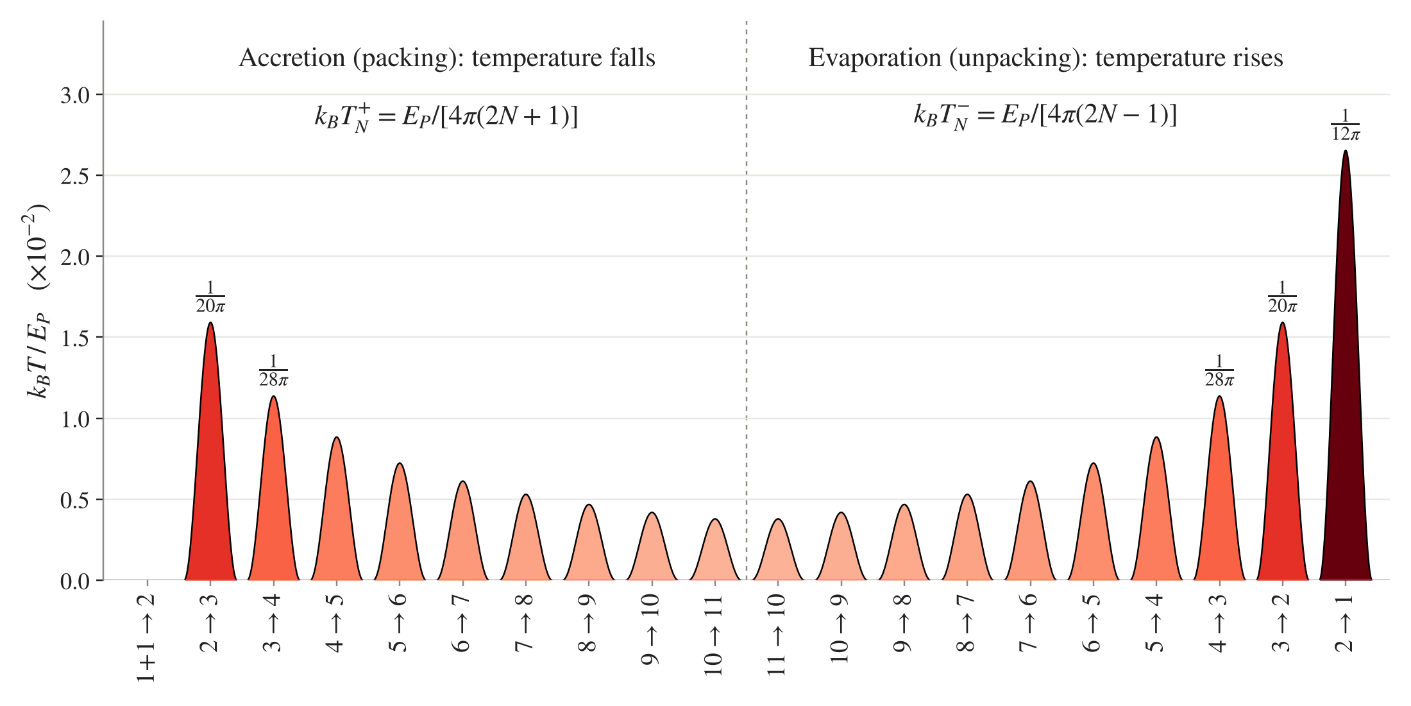
The temperature staircase at the end of evaporation. When \(k_BT\) exceeds the rest energy \(m_ec^2\) of the electron, the lightest charged massive particle, i.e. for \(N\lesssim N^*=E_P/(8\pi m_ec^2)\approx9.5\times10^{20}\) (\(M\approx2.1\times10^{13}\) kg, \(T\approx5.9\times10^{9}\) K), the emitted particles begin to include massive ones; we call this the end stage of evaporation. Within it, the temperature staircase is significant only for \(N\lesssim10^2\). By Eq. (15), the ratio of the emission temperatures of two successive unpackings is
For large \(N\) this is about \(1+1/N\): the temperature rises almost continuously, and the thermal radiation of the many sub-steps adds up to a smooth thermal spectrum. For small \(N\) the temperature jumps step by step, and the number of sub-steps per pack, \(2N-1\), also decreases step by step (Table 3):
| Unpacking | \(k_BT_N^-\) | \(T_N^-\) | Sub-steps |
|---|---|---|---|
| \(4\to3\) | \(E_P/(28\pi)\) | \(1.61\times10^{30}\) K | |
| \(3\to2\) | \(E_P/(20\pi)\) | \(2.26\times10^{30}\) K | |
| \(2\to1\) | \(E_P/(12\pi)\) | \(3.76\times10^{30}\) K | |
The ratios of successive temperatures are \(7/5\) and \(5/3\). The end of evaporation is therefore not a continuous process in which the temperature rises smoothly as \(1/N\), but a set of discrete thermal peaks: the unpacking \(N\to N-1\) emits its \(2N-1\) sub-steps with a thermal distribution at temperature \(T_N^-\), the peak positions being proportional to the temperature and discrete as \(1/(2N-1)\). The stages appear one after another in time and can be identified one by one in a time-resolved spectrum; in a time-integrated spectrum the width of each thermal peak exceeds the spacing between neighbouring peaks, and they merge into a single broad peak. By last-in-first-out, the packing temperatures fall through the same sequence step by step during accretion and rise back through it in the reverse order during evaporation, in one-to-one correspondence (Fig. 2). This staircase structure is the signature of the present framework at the end of evaporation. It differs in nature from the Bekenstein–Mukhanov lines: within each peak the particle energies still follow the thermal distribution of that stage, and what is discrete is the temperature and total energy of each stage, not the frequency of individual particles. Loop quantum gravity also predicts discrete emission lines at the end of evaporation, lying in the Planck energy range, with evaporation ending at about \(0.4\,m_P\) [43]; the same work notes that the pseudo-periodicity of the area spectrum may leave broad peaks in the instantaneous spectrum of larger black holes, though this is not a necessary prediction of loop quantum gravity [43]. In the present framework the smallest black hole is \(N=2\), i.e. \(2m_P\); evaporation ends with the unpacking \(2\to1\), leaving one \(E_c\), and for large \(N\) the spectrum is smooth and reduces to the Hawking thermal spectrum. The staircase is significant only for \(N\) below about \(10^2\): there \(k_BT_N^-\) exceeds \(5\times10^{24}\) eV, far above the rest energies of all known particles (about \(1.7\times10^{11}\) eV for the top quark), and more than four orders of magnitude above the highest energies now detected (about \(10^{15}\) eV for gamma rays and \(3\times10^{20}\) eV for cosmic rays), and this stage lasts about \(10^{-33}\) s. Conversely, bringing the particle energies into the detectable range requires \(N\gtrsim10^6\), where the temperature difference between adjacent packs is about \(1/N\lesssim10^{-6}\), indistinguishable from a continuous thermal spectrum. At the end of evaporation the energy of each sub-step, \(\varepsilon_{N-1}=E_P/(2N-1)\), is shared by only a few particles, and if conserved quantum numbers are balanced by particle–antiparticle pairs within a sub-step and the sub-step releases a single pair, each particle has energy \(E_P/[2(2N-1)]\), so the spectrum at the end may be closer to discrete lines than a thermal peak, its detailed shape depending on the particle species, which is not pursued here.
The coefficient of the logarithmic correction. Loop quantum gravity gives a correction of \(-\frac32\ln A\) or \(-\frac12\ln A\), depending on the counting scheme [44, 45], and some work argues that large black holes have no logarithmic correction [46]. Sen derived the logarithmic correction for Schwarzschild black holes from one-loop (infrared) effects of massless fields, with a coefficient that depends on the massless field content [47]. In the present framework the relational entropy \(4\pi N^2\) of the horizon is exact, and the relational counting itself contains no logarithmic term.