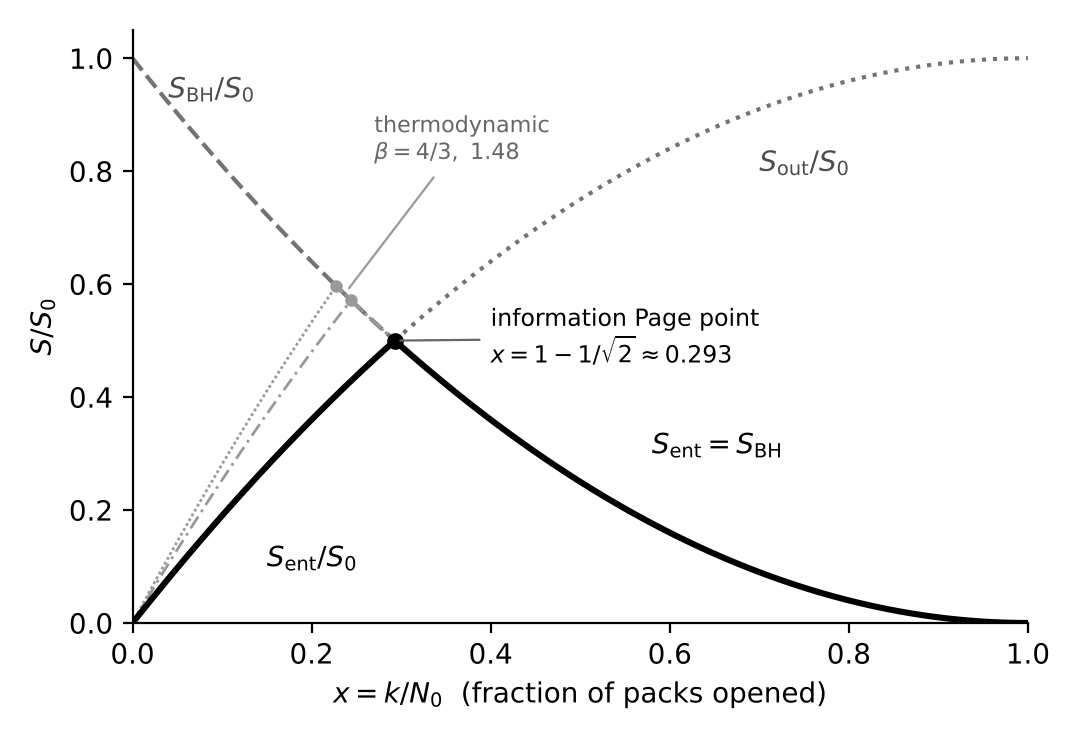
Let a black hole begin evaporating from \(N_0\) packs, and write \(S_0=4\pi k_BN_0^2\). After \(k\) packs have been unpacked, \(N=N_0-k\) packs remain. Write \(x=k/N_0\) (\(0\le x\le1\)), the fraction of packs unpacked, which is also the fraction of energy emitted. For finite \(N_0\) the final unpacking \(2\to1\) occurs at \(x=1-1/N_0\); the remaining capsule and its self entropy are accounted for separately in paragraph (7), and \(x=1\) in the curves below refers to the macroscopic continuum limit.
(1) Black-hole entropy. The black-hole entropy is the coarse-grained entropy of the black hole, i.e. the relational entropy of Section 5. By Eq. (6),
(2) Outflow entropy and conservation of information. On unpacking, the relational entropy lost by the black hole (the self term of the departing pack plus its ordered relations with the packs that remain, i.e. \(-\Delta S_-\) of Eq. (14)) leaves with the dissolved pack and is carried outside the horizon; we call it the outflow entropy \(S_{out}\). Whatever the black hole loses flows out, with nowhere else to go, so
The relational entropy remaining inside plus that which has flowed out always equals the initial total: black-hole entropy, as information entropy, is conserved. Equation (63) holds exactly at every integer step while the black hole exists (\(N\ge2\)); the final step \(2\to1\) is accounted for in paragraph (7).
Consistency check: summing pack by pack. One can also add up the entropy carried off by each pack without invoking the conservation law. By Eq. (14), the entropy flowing out on unpacking \(m\to m-1\) is \(-\Delta S_-=4\pi k_B(2m-1)\). Unpacking in turn from \(N_0\) packs, the 1st unpacking has \(m=N_0\) and releases \(4\pi k_B(2N_0-1)\); the 2nd has \(m=N_0-1\) and releases \(4\pi k_B(2N_0-3)\); …; the \(k\)-th has \(m=N_0-k+1\) and releases \(4\pi k_B(2N_0-2k+1)\). After \(k\) packs have been unpacked, the outflow entropy is the sum of these \(k\) terms:
The bracket is an arithmetic series of \(k\) terms with first term \(2N_0-1\) and last term \(2N_0-2k+1\); its sum equals the number of terms times the mean of the first and last terms, \(k\cdot[(2N_0-1)+(2N_0-2k+1)]/2=k(2N_0-k)\). Hence
identical to Eq. (63). The pack-by-pack sum does not assume conservation of information; it uses only the self term and the number of relations that each pack takes away on leaving. The agreement shows that the conservation law, Eq. (63), is exactly the cumulative result of the pack-by-pack outflow.
(3) Entanglement entropy and the information Page point. Entanglement entropy is a fine-grained (von Neumann) entropy, measuring the quantum correlations actually present between the radiation and the black hole; coarse-grained entropy counts the possible states when only macroscopic quantities are known and is a capacity. If the black hole and the radiation together are in a pure state (unitary evolution), then by the Schmidt decomposition the entanglement entropies of the radiation and of the black hole are exactly equal, denoted by the same \(S_{ent}\). Page pointed out that, for typical states, the entanglement entropy of the two parts is approximately the smaller of their two capacities [15]. From the standpoint of information conservation, the information about the black hole carried by the radiation is the outflow entropy, so
Setting \(S_{out}=S_{BH}\):
Expanding and rearranging gives \(2x^2-4x+1=0\), whose root in \(0\le x\le1\) is
That is, when about 29.3% of the packs have been unpacked, the information of the black hole is exactly half outside and half inside, and the entanglement entropy reaches its maximum \(S_0/2\); thereafter the entanglement entropy decreases with further radiation (Fig. 1). This agrees with Page’s original result [15], and in the present framework it follows directly from the conservation law, Eq. (63).
Within gravitational theory, the Page curve has recently been obtained from the island formula and replica wormholes [36, 37, 38, 39]: after the Page time, part of the black-hole interior (the island) belongs informationally to the radiation. Replica wormholes are Euclidean geometries in the path-integral calculation, not traversable passages, and the physical status of islands in real four-dimensional spacetime is still debated. The present framework does not rely on these constructions: the same curve and the same Page point follow directly from the conservation of relational entropy, Eq. (63), or from the pack-by-pack sum above.
(4) The thermodynamic Page point. Another definition of the Page curve takes the coarse-grained entropy of the radiation as the capacity of the radiation side [16]. In real evaporation the black hole radiates into a vacuum at nearly 0 K; heat flows from high to low temperature, an irreversible process that necessarily produces entropy: the field outside the horizon starts in the vacuum (a pure state with zero entropy), the radiation excites a large number of modes, and the coarse-grained entropy of the radiation therefore exceeds the outflow entropy. Only when the black hole exchanges reversibly with radiation in equilibrium at the same temperature are the two equal. Write
For an ideal black body, unpacking \(m\to m-1\) emits \(E_P\) at the emission temperature \(T_m^-\) (Eq. (15)), with radiated entropy \(\frac43E_P/T_m^-=\frac43\cdot4\pi k_B(2m-1)\), while the outflow entropy of this pack is \(S_{out}=-\Delta S_-=4\pi k_B(2m-1)\), so \(\beta=4/3\) [40]; including greybody factors, counting only photons and gravitons and radiating into empty vacuum, \(\beta\approx1.48\) [16, 22]. Setting \(S_{rad}=S_{BH}\) gives \(\beta x(2-x)=(1-x)^2\). Since \(x(2-x)=1-(1-x)^2\), writing \(y=(1-x)^2\) gives \(\beta(1-y)=y\), \(y=\beta/(1+\beta)\), and therefore
For \(\beta=4/3\), \(x_P'\approx0.244\); for \(\beta\approx1.48\), \(x_P'\approx0.227\).
(5) Relation between the two Page points. They answer different questions. The information Page point \(x_P\approx0.293\) answers “when has half of the black hole’s information flowed out”, depends only on the conservation law Eq. (63) and is independent of \(\beta\); the thermodynamic Page point \(x_P'\) also counts the entropy produced by thermalization outside the horizon as capacity of the radiation, and therefore comes earlier. The extra \((\beta-1)S_{out}\) from thermalization carries no information about the black hole but measures the irreversibility of evaporation: the total coarse-grained entropy
increases monotonically during evaporation, and the generalized second law holds. The difference between the two Page points reflects exactly this entropy production; for \(\beta=1\) (reversible) they coincide. From the informational point of view no correction is needed; from the thermodynamic point of view one is. Black-hole thermodynamics and black-hole information part ways here, and are linked again by \(\beta\).
(6) Carriers of the correlations. The carriers of the outflow entropy are the relations cut across the horizon. In unpacking \(m\to m-1\), the departing pack takes away its self term and its \(2(m-1)\) ordered relations with the \(m-1\) packs that remain; it is therefore correlated with each remaining pack. By last-in-first-out, the departing pack is the last to have entered, and those that remain entered before it. Each relation is cut, and counted, only once, when one of its ends is unpacked, so Eq. (63) counts each relation exactly once. How the radiation thermalizes after crossing the horizon does not affect the information accounts here.
(7) The end point and the content of the information. After the final unpacking \(2\to1\), \(S_{BH}\) falls from \(16\pi k_B\) to zero, leaving one \(E_c\). It has a self term and no relations; and since capsules are intrinsically identical (Section 2), all \(E_c\) have the same self term and cannot record any history of the black hole. The remaining \(E_c\) is therefore not an information-carrying remnant, and the entanglement entropy must return to zero: all the information is in the radiation. The entropy ledger of this step is \(16\pi k_B=12\pi k_B+4\pi k_B\): the \(12\pi k_B\) released by unpacking consists of one self term and two ordered relations; the remaining \(E_c\) is released from the organizing relations of the black hole and returns to the cosmic background, its self entropy \(4\pi k_B\) reverting to the intrinsic entropy of a background capsule and no longer counted as black-hole horizon entropy. Over the whole process \(S_0=S_{out}+S_{bg}\), that is, \(4\pi k_BN_0^2=4\pi k_B(N_0^2-1)+4\pi k_B\), and energy is likewise conserved, \(N_0E_P=(N_0-1)E_P+E_P\). Equations (63)–(68) depend only on the number of packs remaining at each step, not on which pack is unpacked, so the Page curve itself does not require last-in-first-out; but the curve gives only the amount of information in the radiation, not its content. Last-in-first-out supplies this: each pack is unpacked at its packing temperature, and the history returns with the radiation in the reverse order of packing.