The mean registered angular momentum equals the angular momentum brought in, but each capsule individually still has a difference. A capsule registered in the irreducible part (probability \(1-p\)) has a surplus \(L_{in}-\Delta J_{irr}\); one registered in the rotational part (probability \(p\)) has a shortfall \(\Delta J_{rot}-L_{in}\). From Eq. (55),
So the mean surplus per capsule equals the mean shortfall:
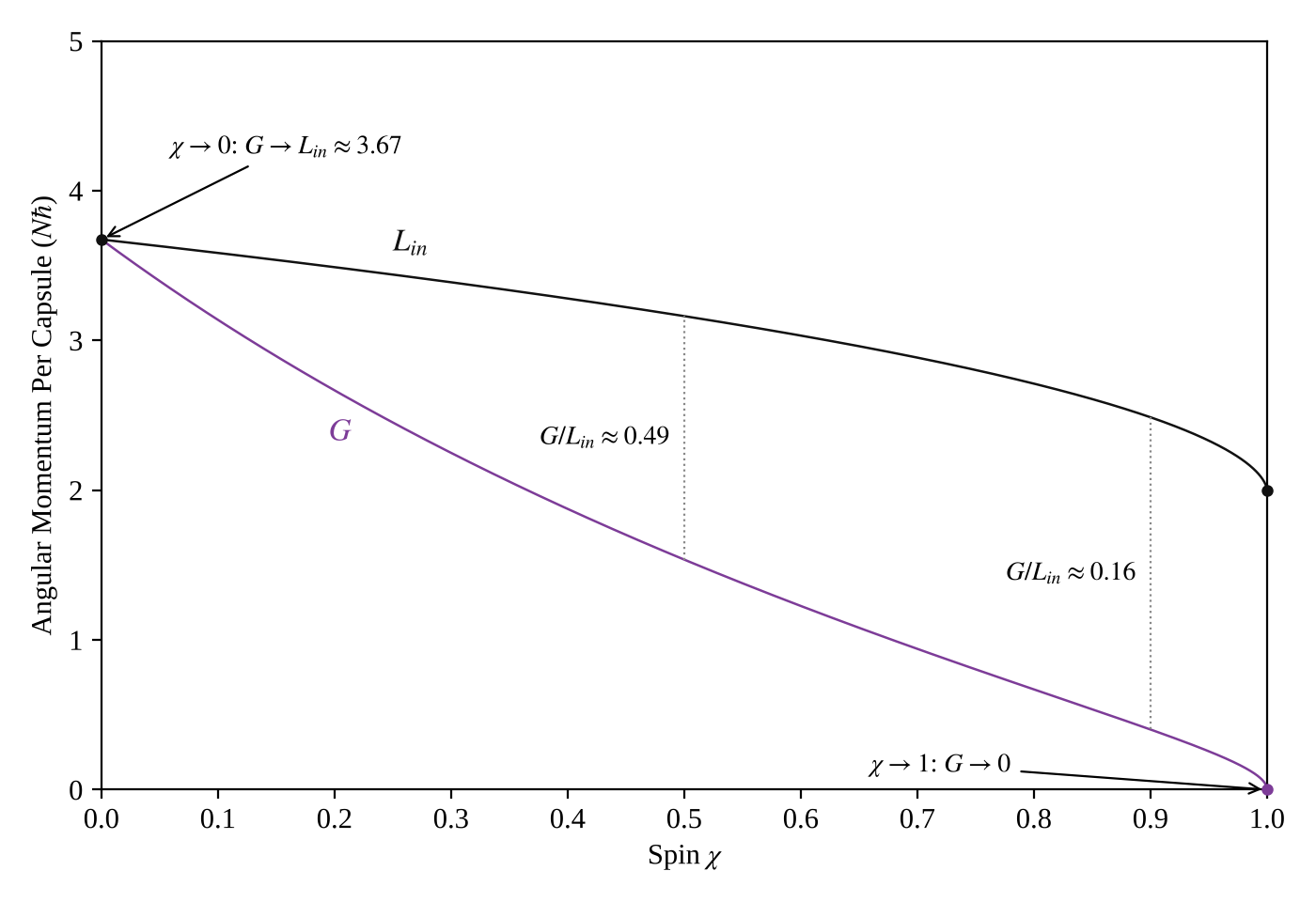
\(G\) is the angular momentum exchanged in both directions between the black hole and its exterior for each pack absorbed. Before entering the horizon no pack has yet formed; matter crosses the horizon sub-step quantum by sub-step quantum: the angular momentum required by the registration is handed to the black hole as a whole with the sub-step quanta, and a capsule carries no angular momentum of its own once registered as a pack; the surplus is handed to the exterior before crossing the horizon, in the plunging region between the ISCO and the horizon, held temporarily by fields or carried away by particles (the electromagnetic field in the magnetosphere, photons, charged particles in jets and so on); the shortfall is made up by the exterior (Section 5.1: the gravitational field, and matter and fields in the accretion disk and magnetosphere). Because each pack is registered locally without coordination, surpluses and shortfalls occur at different places and in different packs and cannot cancel on the spot. Figure 4 shows \(G\) and \(L_{in}\) as functions of \(\chi\): \(G/L_{in}\) decreases as \(\chi\) increases, with \(G\to L_{in}\) as \(\chi\to0\) and \(G\to0\) as \(\chi\to1\).
The surplus angular momentum must have an outlet. Its flux equals \(G\) per pack times the number of capsules absorbed per unit time, is proportional to \(M\dot M\), and weakens as the spin rises: for a black hole that starts accreting from zero spin, with the spin rising gradually, even if the accretion rate grows with mass, the flux falls to about 1/3 of its initial value when the mass has grown by a factor 1.5 (\(\chi\approx0.84\)), and to about 1/8 at a factor 2 (\(\chi\approx0.99\)). Observationally, the fraction of radio-loud AGN rises steeply with black-hole mass [22, 23], and jet power increases with spin [24]; the former is consistent with a flux proportional to \(M\dot M\), while the latter runs opposite to it. So \(G\) is not the main source of powerful jets, which come from the extraction of the black hole’s rotational energy by the Blandford–Znajek process [25]. The effect of the registration difference on the spin is also small: suppose a fraction \(f_{out}\) of the surplus leaves and does not return; even for \(f_{out}=1\), the equilibrium spin is still about 0.9994 (for \(f_{out}\le0.5\) there is no equilibrium and the spin keeps rising), which only makes the spin rise slightly more slowly than in general relativity. In magnetohydrodynamic simulations, jets lower the equilibrium spin to about 0.93 [26], but those jets also extract the black hole’s own rotational energy. What the framework adds is the part of the outflow that necessarily exists at low and intermediate spin; with sufficient magnetic field it can be collimated along the spin axis, and without a magnetic field it is held temporarily by the gravitational field and carried away by radiation.