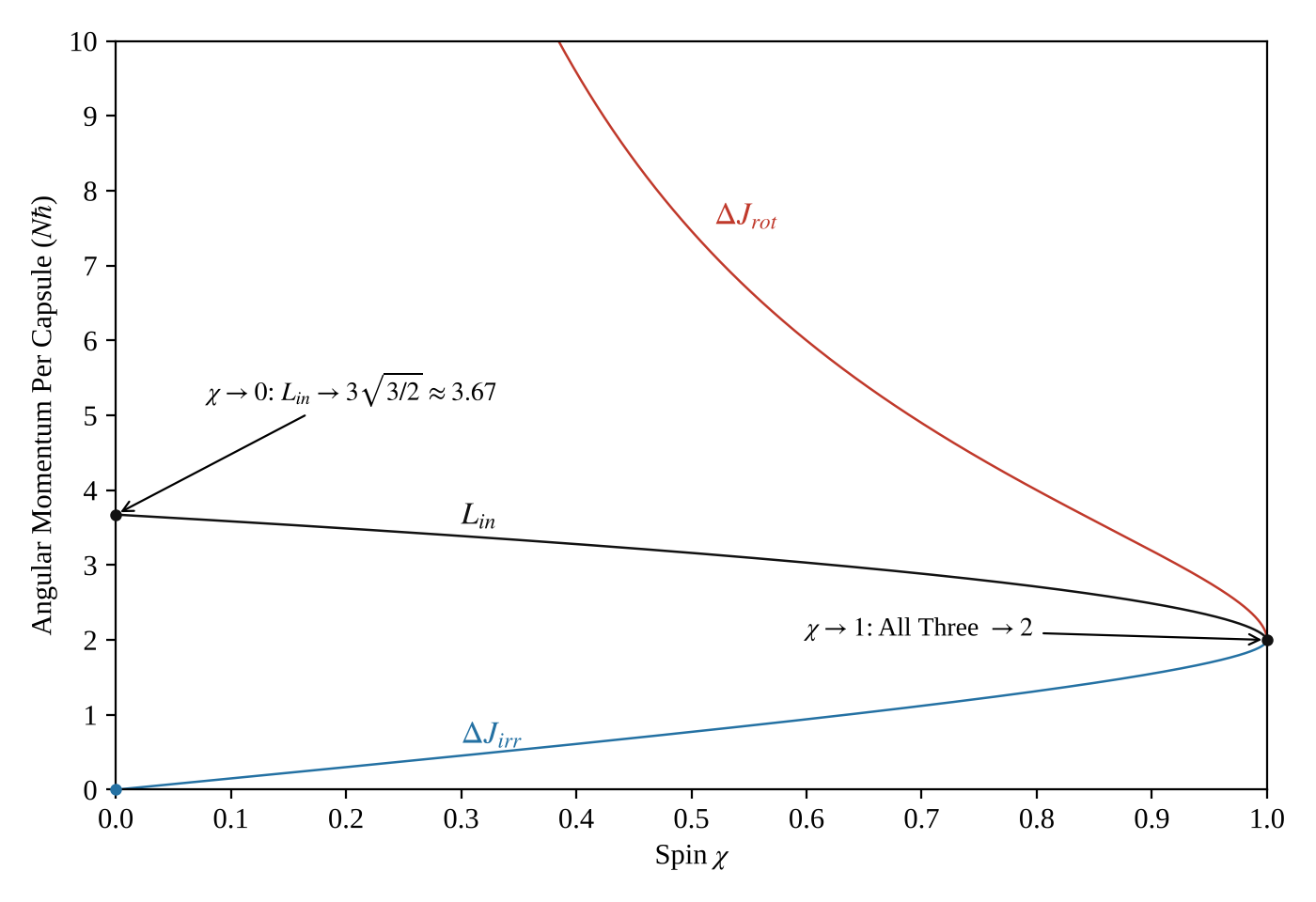
Large-\(N\) approximation. At large \(N\), Eqs. (43) and (44) are differences of two nearly equal large numbers, and their relation to the spin is not apparent. When \(N\) is very large at fixed nonzero spin (\(k\) of the same order as \(N\), \((2N+1)/k^2\ll1\)), adding 1 can be treated as a small change and a first-order approximation used, denoted below by \(\simeq\).
Baseline. From Eq. (6), \(J=\chi N^2\hbar\). When one pack is absorbed or emitted, both \(N\) and \(\chi\) change; to first order by the product rule,
Taking \(\Delta N=\pm1\), dividing both sides by \(N\hbar\,\Delta N\), and using \(\Delta\ln M=\Delta N/N\):
So \(|\Delta J|=2\chi N\hbar\) is the baseline: with registration in proportion to composition (\(p=N_{rot}/N\)), the mean spin is unchanged to first order; the difference between the angular-momentum change of any pack, \(|\Delta J|/(N\hbar)\), and \(2\chi\) is the \(\Delta\chi/\Delta\ln M\) caused by that pack, and \(\Delta\chi/\Delta\ln M\) is determined only by the geometry of the horizon circle. Taking differentials of \(\chi=\sin2\omega\) and of \(\cos\omega=N_{irr}/N\):
Rotational pack (\(\Delta N_{irr}=0\)): substituting into Eq. (47),
From Eq. (46) and \(\Delta\ln M=\Delta N/N\):
Substituting into Eq. (45):
Irreducible pack (\(\Delta N_{irr}=\Delta N\)): substituting into Eq. (47),
where the last step uses the half-angle formula \(\tan(\omega/2)=(1-\cos\omega)/\sin\omega\). From Eq. (46) and \(\Delta\ln M=\Delta N/N\):
Substituting into Eq. (45):
For allowed states \(\omega<\pi/4\) and \(\cos2\omega>0\): rotational packs lie above the baseline and irreducible packs below it, in agreement with the exact conclusion of Section 5.2 (Table 6). The magnitudes in this first-order approximation apply equally to absorption and emission, but are accurate only at large \(N\): for \(N\sim10^6\) they agree with the exact values to four significant figures; at small \(N\) the deviation for rotational packs is large. For example, when \(BH(8,7)\) emits its only rotational pack and becomes \(BH(7,7)\), the exact value is \(\Delta J/\hbar=-54.2\) while the first-order approximation gives \(-28.9\); Eqs. (43) and (44) must then be used.
In general relativity, matter in an accretion disk moves inward gradually along circular orbits and falls into the black hole after reaching the innermost stable circular orbit (ISCO). Denote by \(x=r_{isco}c^2/(GM)\) the ratio of the ISCO radius \(r_{isco}\) to \(GM/c^2\) (dimensionless; \(x=6\) without rotation, i.e. \(r_{isco}=3R_s\)). For a prograde disk [6]
where \(Z_1=1+(1-\chi^2)^{1/3}\left[(1+\chi)^{1/3}+(1-\chi)^{1/3}\right]\) and \(Z_2=\sqrt{3\chi^2+Z_1^2}\).
Disk matter of mass \(m\) moving inward along circular orbits radiates away mass \((1-\tilde e)\,m\) on the way, and its angular momentum is also transported outward by torques within the disk, part of it carried off by radiation; on reaching the ISCO the remaining mass is \(\tilde e\,m\) and the angular momentum \(\tilde l\,m\). After reaching the ISCO all the matter falls through the horizon, so the black hole gains mass \(\tilde e\,m\) and angular momentum \(\tilde l\,m\). We call \(\tilde e\) the accretion coefficient and \(\tilde l\) the specific angular momentum per unit mass of disk matter \(m\) [6]; the radiative efficiency of accretion is \(\eta=1-\tilde e\):
Each capsule absorbed increases the black-hole mass by \(m_P\). From \(\tilde e\,m=m_P\), the disk mass that must fall in is \(m=m_P/\tilde e\), and the angular momentum brought in is \(\tilde l\,m=\tilde l\,m_P/\tilde e\); multiplying numerator and denominator by \(GM/c\) makes the coefficient dimensionless:
Moreover \(GMm_P/c=GNm_P^2/c=N\hbar\) (using \(m_P^2=\hbar c/G\)), so
The two ends: without rotation, \(\chi\to0\), \(x=6\), \(\tilde e=2\sqrt2/3\approx0.943\) (\(\eta\approx5.7\%\)), \(\tilde l=2\sqrt3\,GM/c\), and \(L_{in}=3\sqrt{3/2}\,N\hbar\approx3.67N\hbar\); for \(\chi\to1\), \(x\to1\), \(\tilde e\to1/\sqrt3\approx0.577\) (\(\eta\approx42\%\)), \(\tilde l\to(2/\sqrt3)\,GM/c\), and \(L_{in}\to2N\hbar\) [6].
Figure 3 and the limits at the two ends show that over the whole range \(0<\chi<1\)
The two ends: for \(\chi\to0\), \(\omega\to0\), \(\Delta J_{irr}\to0\), \(\Delta J_{rot}\propto\cot\omega\to\infty\) and \(L_{in}\to3.67N\hbar\); for \(\chi\to1\), \(\omega\to\pi/4\), \(\Delta J_{rot}\to2N\hbar\cot(\pi/4)=2N\hbar\), \(\Delta J_{irr}\to2N\hbar\left(\sin\frac{\pi}{2}-\cos\frac{\pi}{2}\tan\frac{\pi}{8}\right)=2N\hbar\), and \(L_{in}\to2N\hbar\): all three tend to \(2N\hbar\) (shown in the figure as all tending to 2). So a capsule registered in the irreducible part always has a surplus \(L_{in}-\Delta J_{irr}\), and one registered in the rotational part always has a shortfall \(\Delta J_{rot}-L_{in}\). Since registration can only be done in whole packs, a difference between the angular momentum actually brought in and the angular momentum registered is unavoidable.