The density clock. Matter in the parent universe starts from the density \(\rho_c\) of the capsule packs themselves and passes through all lower densities as the universe expands. To compare with the timeline of standard cosmology, we use a “density clock” to express the local density. In a radiation-dominated flat universe the Hubble parameter \(H\) (the expansion rate of the universe; its present value is \(H_0\)) is \(H=1/(2t)\), and the density is related to time \(t\) by
Conversely, the time \(t\equiv\sqrt{3/(32\pi G\rho)}\) corresponding to a local density \(\rho\) is the reading of the density clock for matter there. It is a local quantity, unrelated to the Hubble sphere; the Hubble sphere belongs only to the universe as a whole (Section 4.2).
Setting \(\rho(t)=\rho_c/N^2\) and substituting \(\rho_c=m_P/[(32\pi/3)\ell_p^3]\):
From \(\ell_p=Gm_P/c^2\) we have \(Gm_P=\ell_pc^2\), so \(N^2=c^2t^2/\ell_p^2\), i.e.
where \(t_P=\ell_p/c\), and the last step uses \(m_P/t_P=m_Pc/\ell_p=c^3/G\). Equation (13) is a criterion on the local density: a black hole formed directly where the density clock reads \(t\) contains \(N=t/t_P\) capsules. The density clock starts from the density of the capsule itself, \(\rho_c\) (\(t=t_P\)). \(M=c^3t/G\) has the same form as the horizon-mass estimate in the primordial-black-hole literature [27], but here it comes only from the local criterion \(\rho_c/N^2\). Whether a region satisfying the criterion collapses into a black hole or continues to dilute with the expansion is decided, in the standard picture of random fluctuations, by the threshold \(\delta_{th}\) of the density contrast \(\delta=\delta\rho/\rho\); the classic estimate is \(\delta_{th}\approx1/3\) [28], and more recent analytic and numerical results give about 0.4–0.6 (depending on the amplitude definition used) [29]; we hold that where collapse occurs is decided by the organizational code as the new universe unfolds, not by purely random fluctuations.
Critical mass and evaporation. Whether a black hole can grow depends on its temperature relative to the background: when the Hawking temperature is below the background temperature it absorbs on balance, and when above it evaporates on balance [3]. Setting the Hawking temperature equal to the background temperature gives the critical mass
The background temperature follows from the radiation energy density \(\rho(t)c^2=(\pi^2/30)\,g_*\big(k_BT_{bg}(t)\big)^4/(\hbar c)^3\) together with Eq. (11):
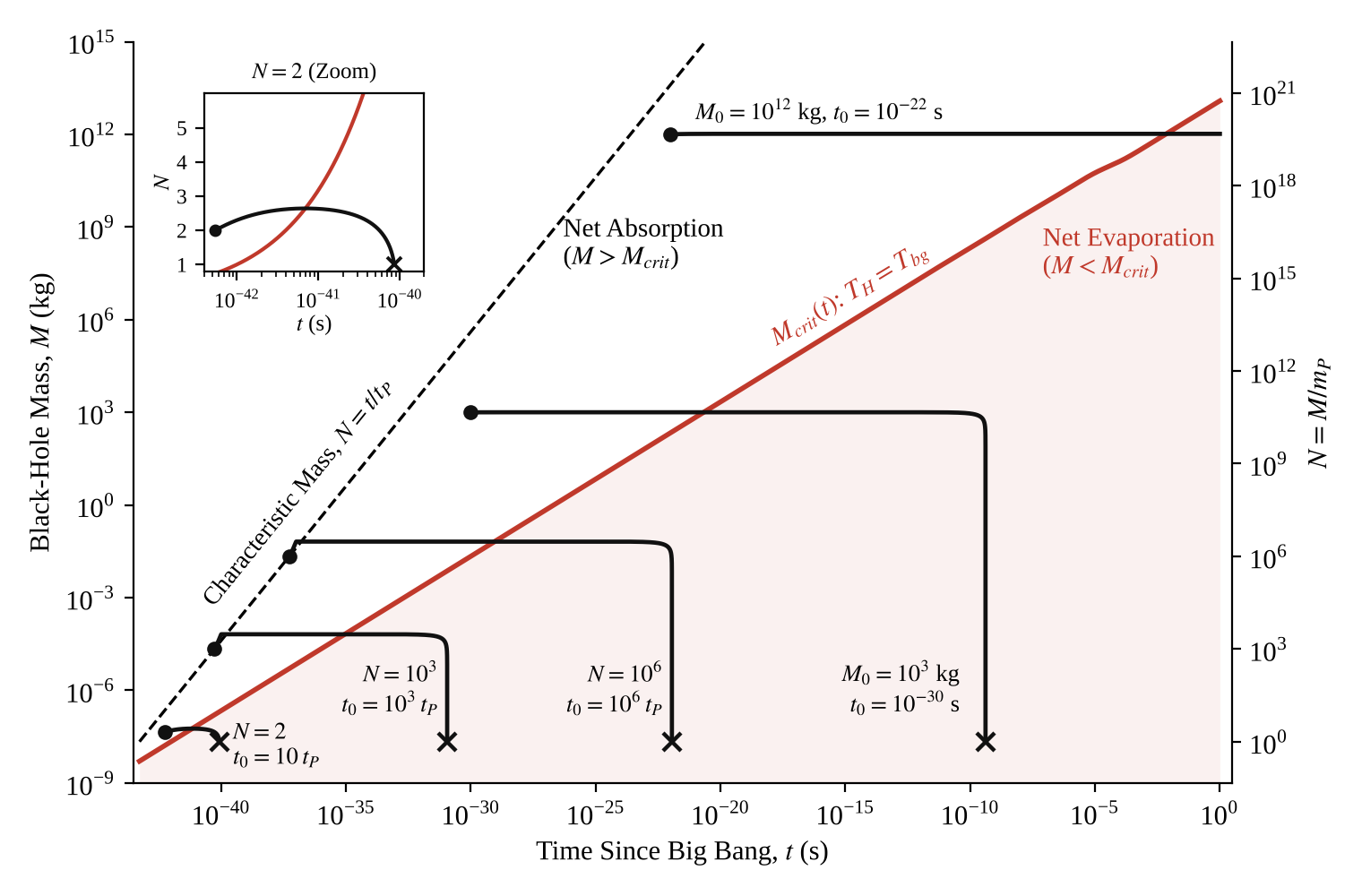
where \(g_*\) is the effective number of relativistic degrees of freedom, which changes stepwise with temperature. Since \(T_{bg}\propto t^{-1/2}\), \(M_{crit}\propto t^{1/2}\); the red line in Fig. 4 is \(M_{crit}(t)\). The concept of a critical mass has been proposed before: Custódio and Horvath equated the rates of radiation absorption and Hawking evaporation and obtained \(m_c\propto T^{-1}\) [30]. By detailed balance, emission and absorption between a black hole and a radiation bath at the same temperature are exactly equal, so rate balance and temperature balance are the same condition. We use temperature balance, whose physical picture is more direct.
Figure 4 integrates the net rate of absorption and emission of the black-hole mass step by step:
The first term in the brackets is the background radiation absorbed by the black hole and the second the radiation it emits at its own temperature; both have the Stefan–Boltzmann form of blackbody radiation, with \(g_*\) taken at the respective temperature. The background temperature \(T_{bg}\) is given by Eq. (15) and decreases with time; the black-hole temperature, \(k_BT_H=\hbar c^3/(8\pi GM)\), decreases with mass. When the two temperatures are equal, \(dM/dt=0\), which is the critical mass of Eq. (14); for \(T_{bg}>T_H\) the black hole absorbs on balance and for \(T_{bg}<T_H\) it evaporates on balance. \(\sigma\) is the absorption cross-section; absorption and emission use the same cross-section, which cancels in the equilibrium condition and affects only how fast the black hole grows or evaporates.
Equation (16) treats the black hole as a blackbody: all radiation falling on the cross-section is absorbed, and emission is computed with the same cross-section. Outside a real black hole the curved spacetime acts as a barrier, and low-energy quanta with wavelengths comparable to \(R_s\) are partly reflected, so both absorption and emission are smaller than for a blackbody and depend on the particle species; this is called a greybody. Computing the greybody effect species by species for all Standard Model particles (\(g_*=106.75\)) gives the grey-body-corrected evaporation lifetime [31]
where \(M_0=Nm_P\) is the initial mass of the black hole and \(f=15.35\) is the weight when all Standard Model particles are counted.
Let \(s\) denote the ratio of the effective absorption cross-section of the black hole to the geometric-optics cross-section, so that \(\sigma=s\cdot27\pi G^2M^2/c^4\). Substituting into Eq. (16), keeping only the emission term and taking \(g_*\) as the constant 106.75, integration gives the evaporation lifetime of the blackbody model
Setting \(t_{ev,\mathrm{black}}=t_{ev,\mathrm{grey}}\) gives
that is, under the above calibration of particle degrees of freedom and lifetime, the mean effective grey-body correction factor is about 0.574, i.e. the effective absorption cross-section is on average about 57% of the geometric-optics cross-section.
Figure 4 shows several kinds of trajectories of early black holes relative to the critical mass. The red line is \(M_{crit}(t)\), the mass at which the Hawking temperature equals the background temperature: above the red line a black hole absorbs on balance and its mass increases with time; below it, it evaporates on balance and its mass decreases. The black dashed line is the characteristic mass \(N=t/t_P\) formed according to Eq. (13); it increases with time and always lies above \(M_{crit}\): at \(t=10^{-40}\) s, \(M=4.0\times10^{-5}\) kg while \(M_{crit}=2.2\times10^{-7}\) kg; at \(t=10^{-20}\) s, \(M=4.0\times10^{15}\) kg and \(M_{crit}=2.2\times10^3\) kg. (1) The smallest, \(N=2\) black hole (see the inset), formed at \(10\,t_P\), grows briefly, is overtaken by \(M_{crit}(t)\) and evaporates within about \(10^{-40}\) s. An \(N=2\) black hole forms by the contact of two capsules, whose local density is \(\rho_c/4\), and does not require the local mean density to satisfy Eq. (13); it therefore lies below the characteristic line (the mean density at \(10\,t_P\) is \(\rho_c/100\)). It forms only during the rapid-creation stage, in which capsules are in mutual contact, and its fate after formation is still decided by \(M_{crit}(t)\). (2) Black holes formed at the characteristic mass (\(N=10^3\) formed at \(10^3\,t_P\); \(N=10^6\) formed at \(10^6\,t_P\)) are all in the net-absorption region when they form, but the growth from absorption is limited, at most a few times (3 times in the figure) [27, 32]; thereafter \(M_{crit}(t)\) catches up with them, they turn to net evaporation, and they evaporate completely at about \(1\times10^{-31}\) s and \(1\times10^{-22}\) s respectively. (3) Heavier ones, such as \(10^3\) kg (formed at \(10^{-30}\) s), evaporate at about \(4\times10^{-10}\) s; \(10^{12}\) kg (formed at \(10^{-22}\) s) survives to the present. The mass-loss rate due to evaporation, \(|dM/dt|\), is proportional to \(M^{-2}\), and a black hole loses most of its mass in the last stage of its life, so the fall is nearly vertical on a logarithmic time axis. Survival to the present is decided by the evaporation time, which is proportional to \(M^3\); a lifetime longer than the age of the universe requires \(M\gtrsim5\times10^{11}\) kg [31], so the survival condition is a mass condition. By Eq. (8), the capsule number and the local density required to form such a black hole directly are
Black holes formed directly where the local density is higher than this value all have masses below \(5\times10^{11}\) kg and will eventually evaporate; only larger black holes formed where the density is lower can survive and keep growing. The starting point of black holes is therefore still \(1+1=2\), but the earliest ones all disappear quickly.
The smallest, \(N=2\) black hole in Fig. 4 represents one round of the \(1+1\to2\to1\) cycle in the early stage of the burst: two neighbouring \(E_c\) combine into an \(N=2\) black hole, and evaporation ends with \(2\to1\), emitting one pack \(E_P\) of radiation and leaving one \(E_c\) [3]. The intrinsic density of background capsules is always \(\rho_c\), and the capsules created rapidly in the early stage of the burst are in contact as soon as they appear, so as long as creation continues, such cycles recur everywhere; how long they last is set not by the mean density but by the duration of the creation stage. The radiation of the early hot state accumulates from this cycle.
This picture is isomorphic to crystallization from solution. In a solution, nuclei smaller than the critical size redissolve and only those larger than it can grow; the smaller the particle, the more soluble it is (the Gibbs–Thomson effect) [33]. The smaller a black hole, the hotter it is and the more easily it evaporates, and \(M_{crit}(t)\) is exactly the “critical nucleus” line. The heat capacity of a black hole is negative, so the larger absorb and the smaller evaporate, just as in Ostwald ripening large crystals grow and small ones dissolve [33].