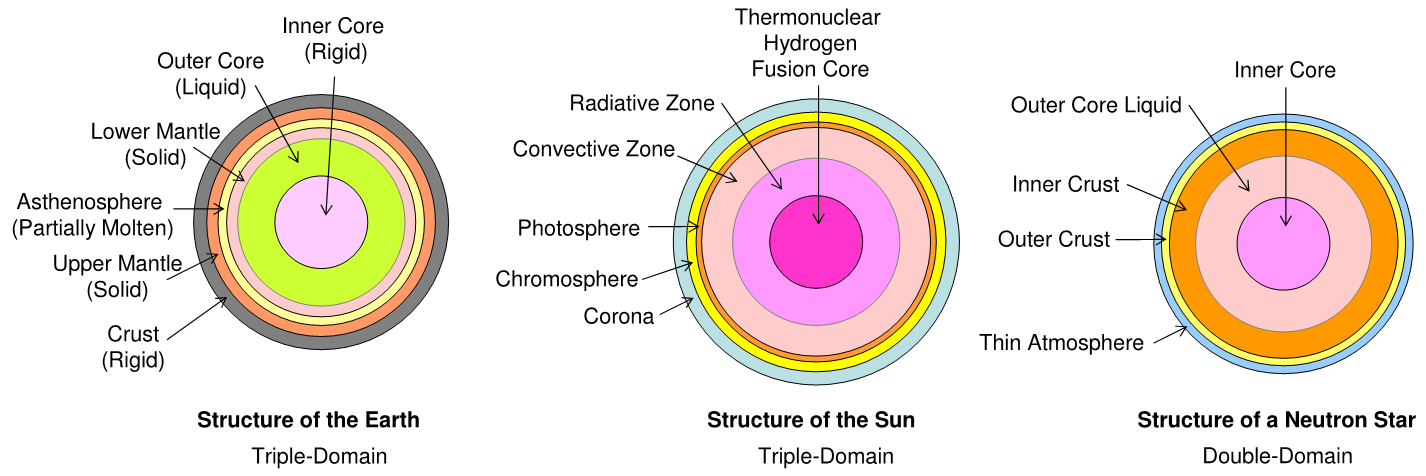
The recurrence of the domain–boundary spatial organization established in our earlier report [1] is also found among macroscopic and even extreme celestial objects. If we set aside for the moment the complex dynamical mechanisms of the various disciplines and compare intuitively only spatial geometric structure and the known layering, the Earth, the Sun and neutron stars, three entirely different objects, likewise show similar nested domain–boundary features, as shown in Fig. 2.
Terrestrial planets (the Earth as an example). In spatial structure, the Earth shows a clear division into layers from the inside out. At the centre is the solid inner core, surrounded by a very thick, hot liquid outer core. Between the deeper solid mantle and the rigid lithosphere (the crust together with the uppermost mantle), i.e. within the upper mantle, lies the asthenosphere, whose material is hot, highly viscous and able to flow slowly, and which acts structurally as a transition and buffer. The outermost layer is the familiar solid crust, which forms the classical physical boundary between the planet and space. The asthenosphere beneath the lithosphere is the underlying reason why continental plates can move. From the centre to the surface the layers alternate as solid \(\to\) liquid \(\to\) solid \(\to\) semi-fluid \(\to\) solid, a clear three-domain–three-boundary structure.
Stars (the Sun as an example). At the very centre is the core, where nuclear fusion takes place; it is enveloped in turn by the radiative zone and the convective zone, where energy is carried outward slowly through countless scatterings and convection, forming a large intermediate buffer phase; the energy is finally radiated into space through the photosphere and chromosphere. The energy carrier undergoes the reversal “radiative zone (mainly photons) \(\to\) convective zone (mainly plasma) \(\to\) photosphere (mainly photons)”, and the three-domain–three-boundary structure is expressed in this reversal of the energy carrier.
Neutron stars. A neutron star is the compact remnant left after gravitational collapse and a supernova at the end of stellar evolution, with a mass of about 1.35–2.1 solar masses and a radius of only about 10–14 km (diameter about 20–28 km), supported against gravity by neutron degeneracy pressure; above the TOV limit (about 2.2–2.3 solar masses) it collapses into a black hole (Section 3.2 gives the criterion for this collapse in the present framework). From the inside out there are the inner core (superfluid neutrons and superconducting protons), the liquid outer core, the inner crust (a mixture of solid lattice and superfluid), the outer crust (a lattice of heavy nuclei and free electrons) and an extremely thin atmosphere, the layers evolving as semi-fluid \(\to\) fluid \(\to\) semi-fluid \(\to\) solid. Because a neutron star comes from a burnt-out star, the original three-domain–three-boundary structure degenerates into a two-domain–two-boundary structure.