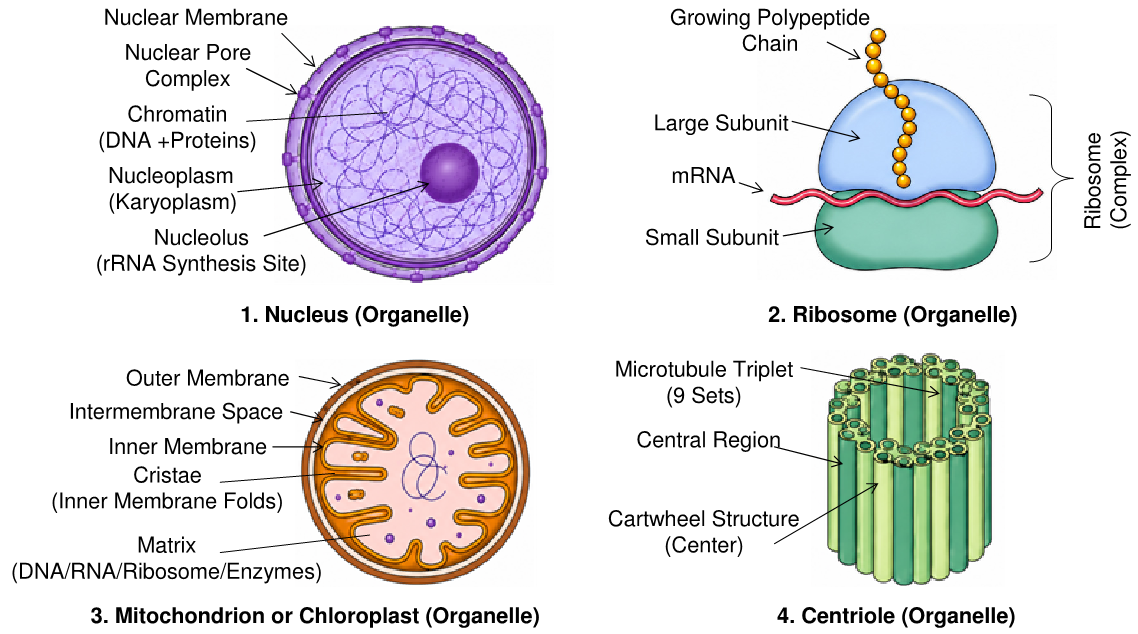
A complete cell requires not only a stable spatial organizational structure but also the vital activities of preserving and interpreting genetic information, producing structural components, supplying energy, and regulating cell division. Beyond the structural organelles, therefore, another class of organelle responsible for these core life functions must exist. This paper refers to the nucleus, ribosome, mitochondrion — and, in plants, the chloroplast — together with the centriole, collectively as functional organelles as illustrated in Fig. 12.
Unlike structural organelles, which are mainly responsible for establishing and maintaining the cell’s spatial organization, functional organelles are mainly responsible for preserving, interpreting, and executing life’s information and for energy conversion, supplying the driving force and material basis for the cell’s continued growth, self-renewal, and autonomous replication. Together they constitute the core of the cell’s functional system.
Functional organelles can be divided, according to their primary function, into four basic functional modules.
Nucleus: Information storage and regulation. The nucleus is the core of a cell’s genetic information. It preserves not only DNA sequence information but also multiple layers of structural information, including that of chromosomes, chromatin, and nuclear architecture, and governs the cell’s vital activities through DNA replication, RNA transcription, and gene regulation. The nucleus therefore serves as both the primary repository of sequence information and an important organizing center for structural information, providing a long-term, stable informational foundation for the entire cell.
Fig. 12 The four functional organelles of a cell
Ribosome: Information interpretation and component production. The ribosome interprets the genetic information carried by mRNA and synthesizes proteins according to the codon sequence, serving as the direct executor that translates genetic information into cellular structure and function. Nearly all structural components and functional proteins within the cell depend on the ribosome for their synthesis; the ribosome thus links genetic information to cellular structure and constitutes a core functional module in the execution of life’s information.
Mitochondrion and chloroplast: Energy conversion. The mitochondrion carries out cellular respiration and ATP synthesis, supplying continuous energy for all of a cell’s vital activities; the chloroplast in plant cells converts solar energy into chemical energy through photosynthesis, providing the primal energy source for the entire biosphere. Notably, both mitochondria and chloroplasts possess their own DNA, RNA, and ribosomes and can carry out part of their protein synthesis, giving them a degree of genetic independence. This distinctive feature further illustrates that the functions of life are not concentrated in a single structure but are accomplished through the coordination of multiple functional modules.
Centriole: Cellular organization and division. The centriole participates mainly in microtubule organization, cytoskeletal reconstruction, and the formation of the mitotic spindle, playing an important role in the spatial organization and division of the cell. Although it is not directly involved in the expression of genetic information or protein synthesis, it coordinates the establishment of the cell’s spatial organization, enabling the cell to maintain stable organizational order throughout division; it is thus an important functional module linking spatial organization to cell replication.
These four functional organelles each perform a distinct role — preserving genetic information, interpreting genetic information, converting energy, and regulating cellular organization — dividing labor while cooperating with one another, and together with the fifth category, the structural organelles, constitute the structural and functional system of the complete cell. At this point, structure, function, and information achieve, for the first time, complete coupling within the same living system, enabling the cell not only to maintain its existing structure but also to continually generate new structure, preserve and transmit genetic information, and carry out vital activities such as autonomous growth, self-maintenance, and cell replication.
A complete cell is therefore not a simple collection of organelles, but a unified organizational system formed by the tight coupling of multiple structural and functional modules. From this level onward, structure, function, and information no longer evolve independently, but together constitute an inseparable whole underlying vital activity, laying the foundation for the subsequent formation of multicellular tissues, organs, and complete organisms.