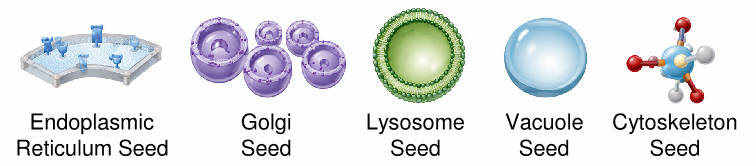
A complete cell requires not only genetic information to direct protein synthesis, but also the capacity to restore complex spatial organizational structure. At the cellular level, therefore, information manifests not only as DNA or RNA sequence, but also as the structural information needed to preserve and restore spatial organization. After cell division, a new cell can re-form complex structures such as the endoplasmic reticulum, Golgi apparatus, lysosomes, vacuole, and cytoskeleton — showing that what life inherits is not only genetic information, but also the organizational information required to restore these structures.
Compared with crystal seeds in non-living systems, structural organelles not only preserve an organizational template but also possess a degree of active organizing capacity. They participate in processes such as structural sorting, packaging, transport, renewal, and spatial organization, and can therefore be regarded as an intermediate functional level between a purely structural template and a functional organelle.
Fig. 11 The five structural organelles of a cell
This paper refers to the endoplasmic reticulum, Golgi apparatus, lysosomes, vacuole, and cytoskeleton collectively as structural organelles. Together they constitute the internal spatial organizational network of the cell and can be regarded as structural organelle seeds, as illustrated in Fig. 11, required to restore the corresponding structures. These seeds do not directly determine the expression of genetic information, nor are they the primary producers of cellular structural components; rather, they preserve the organizational template needed to restore their own structure and provide a stable spatial organizational platform for the various functional modules.
The main organizational roles of the five structural organelles are as follows:
Although these structural organelles possess a degree of active organizing capacity, their primary responsibility remains the maintenance and restoration of the cell’s spatial organizational structure, rather than the reading of genetic information, large-scale protein synthesis, or energy conversion. The relevant structural components are produced mainly by the functional organelles and, guided by the structural template, are progressively restored into a complete structural system through transport, self-organization, and assembly.