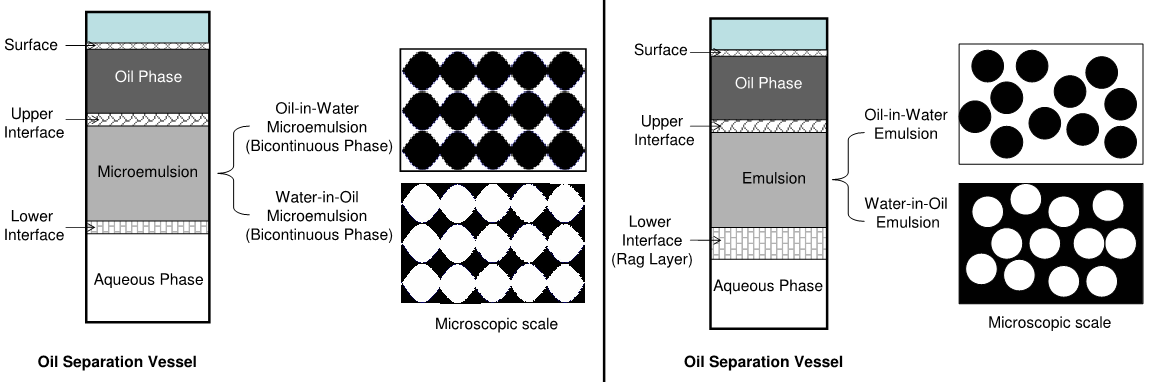
The previous section used milk, cream, and butter as examples to show that emulsion systems can undergo continuous organizational reconstruction as their interfacial organizational relationships change. These familiar food systems, however, illustrate only part of the organizational behavior of emulsions. Industrial emulsion and microemulsion systems as shown in Fig. 4 display richer organizational forms, offering more representative non-living examples for analyzing the formation, stabilization, and transition of multi-domain organization.
Industrial microemulsions are highly thermodynamically stable dispersion systems with particle sizes of 10–100 nm. Unlike biological systems, microemulsions possess no life activity, yet they are capable of forming a highly ordered, liquid-crystal-like intermediate phase with a bicontinuous organizational structure, which may be either oil-in-water or water-in-oil in type. Surfactants serve as the interfacial mediator; the intermediate phase constitutes an organizational domain, while the oil phase and aqueous phase constitute the interacting subject domains, together forming a typical triple-domain/triple-interface structure, whose three interfaces are the upper interface, the lower interface, and the oil surface. Conditions such as ambient temperature and pressure, the concentration of inorganic salts in the aqueous phase, and the type or concentration of surfactant can all cause the microemulsion type to invert.
Fig. 4 Triple-domain structure: Microemulsion and emulsion systems
Industrial emulsions are dispersion systems in which most particle diameters range from 1–5 μm, with a small fraction of larger particles reaching up to 1000 μm. They differ considerably from industrial microemulsion systems in that their intermediate phase is thermodynamically unstable, yet displays considerable kinetic stability, remaining resistant to breaking over long periods. The interfacial layer beneath may be thin or, in industrial settings, quite thick — sometimes as much as ten feet — and is termed the rag layer. The rag layer is not simply a disordered mixture; it behaves as a highly viscous, highly damped, complex viscous fluid phase, forming a natural intermediate buffering and damping domain within industrial separators, with clearly organizational behavior: formation, evolution, collapse, reconstruction, and long-term stable existence. Within the framework of this paper, the rag layer can likewise be regarded as a representative intermediate organizational domain, whose behavior is influenced not only by material composition but also by ongoing informational exchange processes. Such complex emulsion systems spontaneously transition from a triple-domain to a quadruple-domain structure. Industrial oil–water systems thus provide an important real-world model for studying the mechanisms of organizational formation.
At the microscopic level, however, both conventional oil-in-water (O/W) and water-in-oil (W/O) emulsions also present a single-domain, single-membrane structure. Under special conditions, water-in-oil-in-water (W/O/W) or oil-in-water-in-oil (O/W/O) double-domain, double-membrane microstructures can also form.
The rectangular diagram is particularly well suited to explaining the macroscopic organizational structure of industrial oil–water separators, while the circular diagram is particularly well suited to explaining the microscopic organizational structure of emulsion systems.
Whether in food emulsions or industrial emulsions, organizational state is determined by interfacial organizational relationships rather than by specific material composition. Continuous organizational transitions between different organizational states, driven by interfacial reconstruction and phase inversion, show that the Domain–Boundary framework describes a general organizational regularity, not one confined to living systems. Building on this, the next chapter further discusses structural recurrence and structural recursion, analyzing how this unified organizational regularity continues to unfold across different scales.