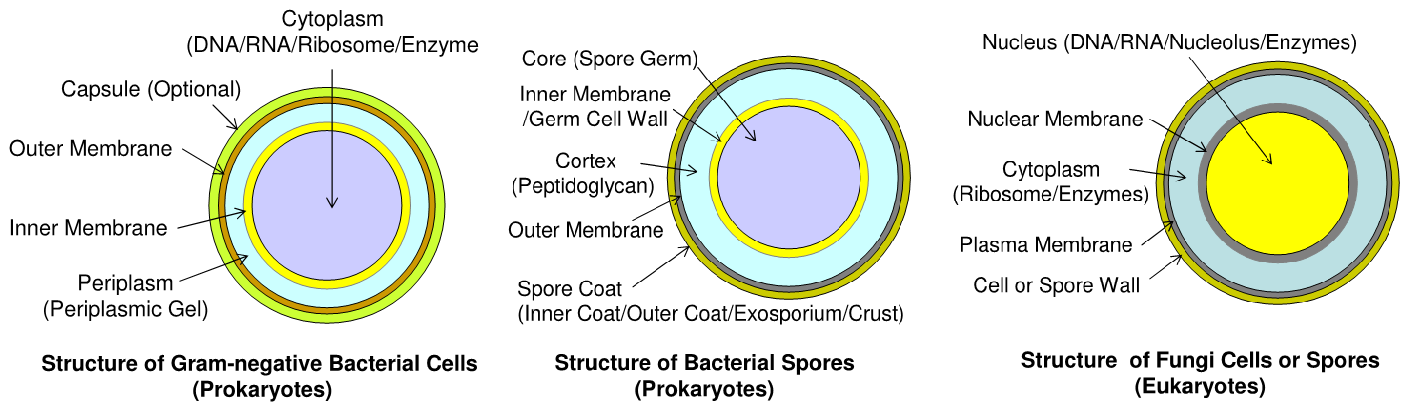
Across biological, chemical, and engineering systems, the second widespread organizational form is double-domain structure. As shown in Fig. 3, a double-domain structure consists of two mutually independent organizational domains that continuously exchange matter, energy, and information through a stable interface. Unlike single-domain structure, double-domain structure does not simply add boundary layers; rather, it forms a new organizational domain on top of existing organization, thereby establishing a higher-level organizational relationship.
Two mutually immiscible organizational domains, if brought into direct contact, will typically separate rapidly and fail to form long-term stable organization. However, nature widely employs a mechanism — interfacial mediation — capable of simultaneously maintaining organizational independence and organizational exchange capacity. In physicochemical systems, surfactants serve as typical interfacial mediators, promoting the formation of a stable interface by lowering interfacial tension; in living systems, phospholipids, membrane proteins, glycolipids, and various natural biosurfactant structures serve the same role. From cell membranes and organelle membranes to pulmonary surfactant and lecithin in egg yolk, all illustrate that interfacial mediators are not unique to living systems, but a common material basis for the formation of double-domain organization.
Fig. 3 presents three representative types of double-domain structure. Gram-negative bacteria establish a stable double-domain organization through the periplasm formed between the outer membrane and the inner membrane; although metabolism in bacterial spores is nearly completely arrested, the core region remains enclosed by an inner membrane, forming a typical double-domain structure together with the cortex and outer coat; and fungal cells and fungal spores define, respectively, the nucleus and cytoplasm as two organizational domains bounded by the nuclear membrane and the plasma membrane. Although these three cases differ markedly in physiological state, metabolic level, and structural composition, they all follow the same organizational regularity: two independent organizational domains coupled continuously through a stable interface, jointly constituting a higher-level organizational system.
Fig. 3 Double-domain structure: Unicellular prokaryotic and eukaryotic microorganisms
Milk, cream, and butter offer the most familiar and intuitive everyday examples of double-domain structure. Milk is essentially a typical fat-in-water emulsion, containing approximately 3.6% fat and 3.2% protein. Milk fat remains stably dispersed in the continuous aqueous phase over long periods not because oil and water are naturally miscible, but because each milk fat globule is coated with an extremely thin milk fat globule membrane (MFGM). The MFGM consists mainly of membrane proteins and phospholipids; it maintains the independence of the milk fat organizational domain while allowing it to coexist stably with the surrounding aqueous phase, thereby constituting a typical interfacial mediator.
Cream typically has its fat content raised to 30–38%, close to the practical upper limit of fat concentration at which liquid cream remains stable without breaking during processing. Unwhipped liquid cream retains the same fat-in-water organizational structure, with fat dispersed in a continuous aqueous phase, except that the milk fat organizational domain is further enriched. Under sustained mechanical agitation, some fat globule membranes rupture, fat particles link together to gradually form a continuous fat network, and large amounts of air are introduced into the system to form a new dispersed phase, resulting in an air-in-fat-in-water (A/F/W) foam structure. Upon further separation, the fat content ultimately reaches approximately 80%, forming butter, whose organizational structure has transformed into a water-in-fat solid emulsion. The progression from milk to liquid cream, to whipped cream, and finally to butter is not four independent foodstuffs, but the result of the same emulsion system undergoing continuous organizational reconstruction under different interfacial conditions, reflecting the continuous organizational evolution among single-domain structure, double-domain structure, and a reorganized single-domain structure.
The examples above show that double-domain structure is not confined to living systems but is widespread among stable organizations throughout nature. Whether cell membranes, organelle membranes, biosurfactants, or milk fat globule membranes and industrial surfactants, their common function is to maintain, through interfacial mediation, a long-term stable organizational relationship between two organizational domains. The next section further uses industrial microemulsion and emulsion systems as examples to show how this organizational regularity extends to the more complex triple-domain structure.