To establish the Unified Recursive Organization Theory, this chapter first defines the basic organizational concepts used throughout the paper and, on this basis, constructs the Domain–Boundary framework. Unless otherwise specified, all subsequent discussion is built on these fundamental definitions.
Traditional science typically describes natural systems in terms of matter, energy, or information, whereas this paper focuses on a more basic organizational fact: In the present theory any stable organization simultaneously possesses a bulk state and a surface/interface state. The bulk constitutes the main body of the organization and is responsible for preserving matter, energy, and organizational information; the surface constitutes the region of interaction between the organization and its environment, responsible for mass exchange, energy exchange, momentum transfer, charge transfer, and various forms of information exchange. The surface is therefore not a passive geometric boundary, but the starting point for organizational exchange, organizational coupling, and the formation of new organization.
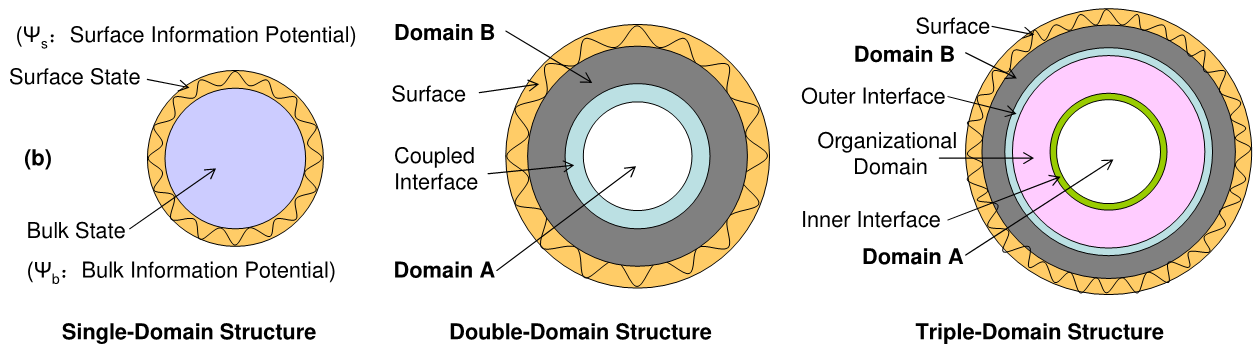
Fig. 1 General model of domain organization
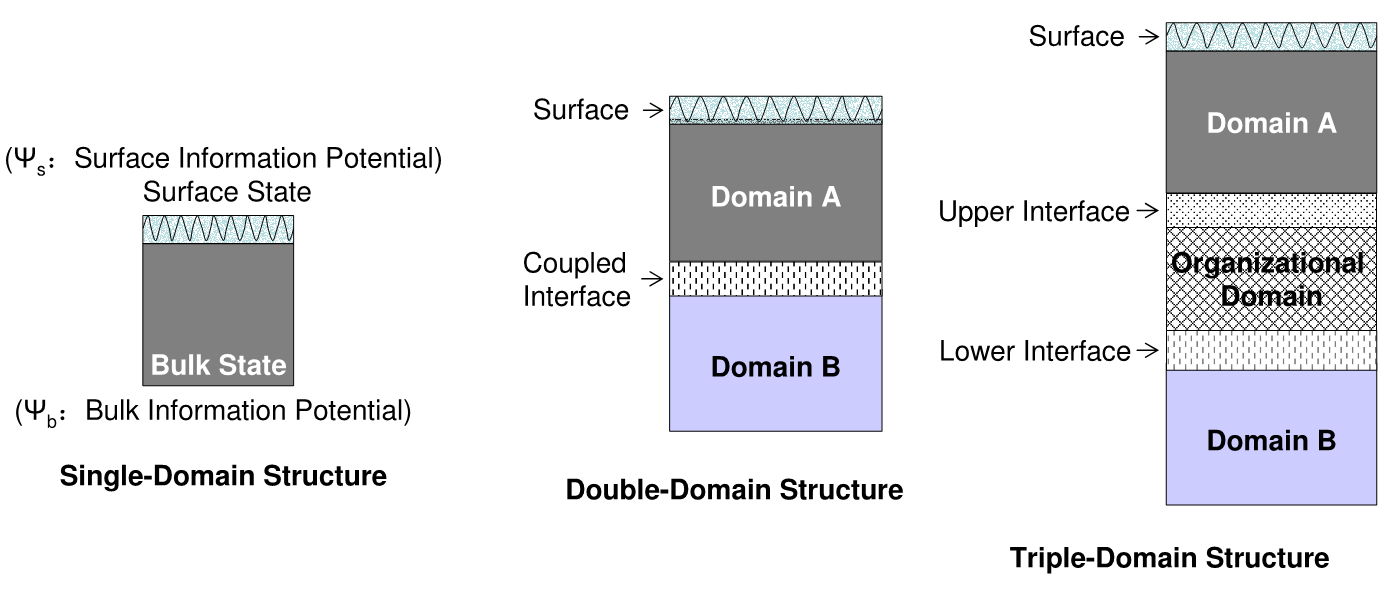
The distinctive character of surfaces and interfaces arises from an electron distribution that differs from that of the bulk interior. Because different atoms, molecules, or material phases differ in electronegativity, charge density, and local structure, the electron distribution at a surface is generally in an organizational state distinct from that of the bulk phase. Since electron distribution is fundamentally governed by the laws of quantum mechanics, the electronic structure of a stable surface can be described by specific quantum states. This view is consistent with the matter-wave theory proposed by Louis de Broglie (1924). Based on this organizational property, this paper uniformly represents the bulk as the bulk information potential Ψb and the surface as the surface information potential Ψs, describing, respectively, the preservation and the exchange of organizational information, as shown in Fig. 1. It should be noted that the term “in formation potential,” as used in this paper, follows the same usage as “potential” in physical chemistry (e.g., chemical potential): a potential is itself an attribute intrinsic to the system in a given state, rather than an independent entity external to and corresponding with the system; at the same time, it is precisely this attribute that drives the system’s spontaneous direction of evolution. This understanding underlies the use of Ψ throughout the paper.
Surface states belong to individual domains; their surface states couple to form an interface when adjacent domains interact. Under suitable conditions, a coupled interface may grow, stabilize, and eventually evolve into a new organizational domain. The rectangular model in Fig. 1 emphasizes organizational relationships among domains, whereas the circular model emphasizes structural enclosure and boundary architecture; both representations describe the same underlying domain organization principle from different perspectives.
Extending this analogy with "potential" further, one may speculate that if information content I is treated as an extensive variable, the information potential Ψ defined in this paper might, by analogy with chemical potential, be incorporated as its conjugate intensive variable into the fundamental thermodynamic equation for internal energy:
dU = TdS − PdV + Σμᵢdnᵢ + ΨdI (1)
If I is measured in bits, Ψ then carries units of energy per bit, corresponding directly, in dimensional terms, to the minimum energy cost of information erasure given by Landauer's principle (kT ln2 per bit) (1961); Ψ might thus be understood as the value this bound takes in a specific organizational system. It should be made clear that this expression is, at present, only an exploratory extension based on a formal analogy with "potential," and is not empirically validated in this paper; a precise, operational definition of I — how "one unit of information" should be defined and measured in a specific biological or physical system — remains a question for future work. This expression is offered here solely to leave a formally self-consistent theoretical entry point for subsequent quantitative research.
Every independent organizational domain is defined by its boundary. A boundary may take the form of a surface, an interface, a membrane, or a layer; these are simply different manifestations of the same organizational concept at different scales, with different physical properties, or in different disciplinary contexts, rather than distinct organizational concepts. A region can be defined as an independent domain only if it has a relatively stable, repeatably identifiable boundary capable of maintaining organizational independence; a region undergoing continuous gradual change, without a stable boundary, does not constitute an independent organizational domain.
The basic organizational principle of this paper can be summarized as: the boundary defines the domain, the domain carries function, and function maintains the independence of the domain. When adjacent domains interact continuously, their surface information potentials Ψs couple with one another to form an interface; under suitable conditions, the coupled interface may further grow and stabilize, eventually evolving into a new organizational domain. Higher-level organization is therefore not a simple superposition of pre-existing organization, but a new organizational level formed recursively through the continuous coupling of existing organization.
Based on this organizational principle, this paper uniformly classifies natural organization into single-domain, double-domain, and triple-domain structures according to the number of organizational domains, rather than the number of boundary layers. A domain may be enclosed by one or multiple boundary layers, but a new domain is defined only when a new subject region with an independent organizational state is formed. Accordingly, all classifications of single-, double-, and triple-domain structures in this paper use the number of organizational domains as the sole criterion, rather than the number of membrane or boundary layers.